Hey everyone! It sure has been awhile, huh? Welcome to Nowhere hasn’t gone anywhere but we’ve been slowly chipping away and trying to polish it. Some things we’ve done since our last blog post was get some external playtesting done at Protospiel Chicago and through the Break My Game discord. We also have social media (@HoneyCoGames on all platforms). Also, if it’s not obvious already we redid the website!
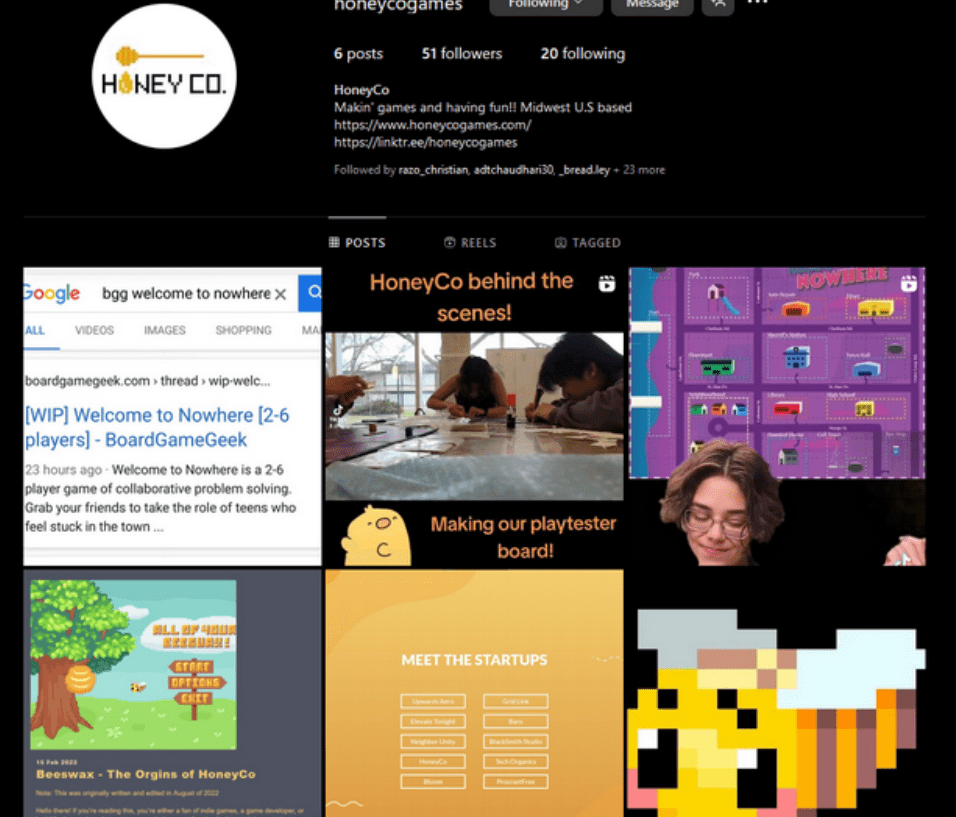
In terms of upcoming events in the near future we’ll have more external playtesting at the upcoming Protospiel Online in May and our BGG thread [https://boardgamegeek.com/thread/3263949/wip-welcome-to-nowhere-2-6-players] has sign ups for playtesting. So you can see us in May or try out the game for yourself sooner than that.
But today, we’re here to talk about two different decks of cards, the problems they encountered, and how we changed them. (And how we changed them, again…) I’ll pass it to Bradley to start with Scenarios.
Writing Calls and Wanting Responses
Designing Nowhere sometimes feels like a one step forward, two steps backwards situation. I’m sure I’m not alone in that sentiment when it comes to making games in general. As of now we believe that our characters and core mechanics are in a pretty good place right now (don’t worry, we’ll get around to making a blog about the characters eventually). Scenarios are a major aspect of our game that felt like one of those moments.
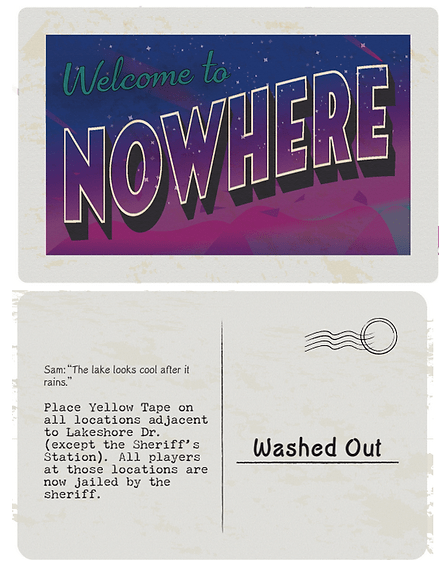
Scenarios worked like this: at the beginning of the round, a player draws a scenario card which immediately takes effect unless said otherwise. The deck was 60 cards designed to be worn down retro postcards was a relative 50/50 split between harmful and helpful scenarios. The goal of these scenarios was to be a random element round to round forcing players to adapt and be flexible with their strategies as we don’t want players a straight shot to victory. It seemed fine and fun at first, but over time more playtesting revealed that there were too many helpful scenarios, some scenarios weren’t brutal enough where players didn’t care, or they were too brutal where one wrong step in the previous round could lead to disaster that made it not fun. There was a location interaction in the Neighborhood to see the upcoming scenario to give the players a forewarning but it wasn’t used often enough. The idea was there, but our execution was off.
So we stepped back, looked over the list of scenarios and discussed why they weren’t fulfilling the goal they intended. It became clear that the majority of the harmful cards were just trying to catch players and punish them when they could. Sure, there were ways to prevent / get out of jailing, but with how scenarios were set up, jailing felt unfair from a player’s perspective. It was the design of the scenario cards that gave me an idea of how to reframe scenarios; if scenarios are designed to be a postcard, then shouldn’t the scenario give time for the players to “write back”?
With this in mind we decided that a majority of scenarios stated that their effect would take place at the end of the round. This would give players a round to respond to the scenario while still giving them time to do what they want. We ended up cutting a lot of cards and creating some new ones with the deck being 54 cards and the split between helpful and harmful cards was about 10:90. While some scenarios are brutal, especially when played back-to-back, players should be able to obtain or use the resources they have on hand to prevent a game over.

The Journey to Destinations
Now to talk about something a bit new to the game. The game at its base felt fine, but it always felt like there was one thing missing. Enter destination cards. We tried making players each draw a card that presented itself as a goal or a challenge that they must complete or work through with other players in order to escape. The destinations had to be completed in order to win. We started by trying to have these in all playthroughs, and we enjoyed it. This deck only contains 30 cards, there’s enough to keep the game fresh for multiple playthroughs of the game and if needed, we can try to think of more.
(Guinevere’s family are tied to the media and advertisment distributions in the area!) Much like the scenarios, there were a lot of similar problems with destinations. And the solution to fixing destinations was quite simple: integrate destination cards into the base game and balance the cards from there. This was a bit of a scary thing for us to do as the game would be more complex, and we were back and forth on what to do. Joe had a hunch it would be too hard for new players, but we kept it for now. All destinations are completable and don’t have conflicting goals but difficulty does vary so some combinations of destinations may be harder than others. We like that team communication is very important in helping each other complete their destinations.
However, that wasn’t the full story. We ran playtests with players who had little-to-no exposure to the game, and found that the destinations were pretty confusing for new players. In the end, we decided to limit destinations as a mechanic for replayability, so that new players aren’t too confused.
And that’s all I have to say about scenario and destination cards. We’re quite happy with the changes made to the decks both in their effects and mechanics. I promise that the next blog will be about the characters for real. But I won’t be the one to write it. Until then!
-Bradley Estacio, Game Designer (Edited by Joshua Prila)
 HoneyCoGames